
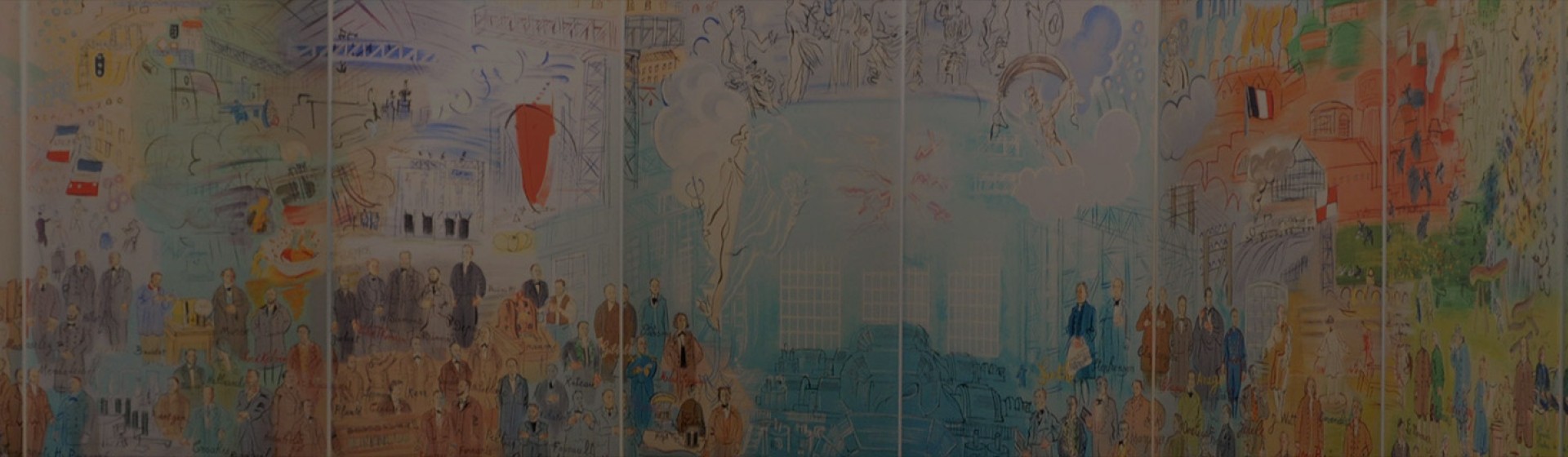
Representations of electricity
When in the second half of the 19th century electricity made its public appearance at the great international and universal exhibitions, it fascinated many artists.
From allegorical statues that adorned the pavilions of these exhibitions, such as the spelter statuette by Charles Octave Levy (1880) exhibited at the museum, to the giant painting The Electricity Fairy by Raoul Dufy in 1937, the works presented bear witness to the artists’ desire to give form to this “divinity of modern times”.
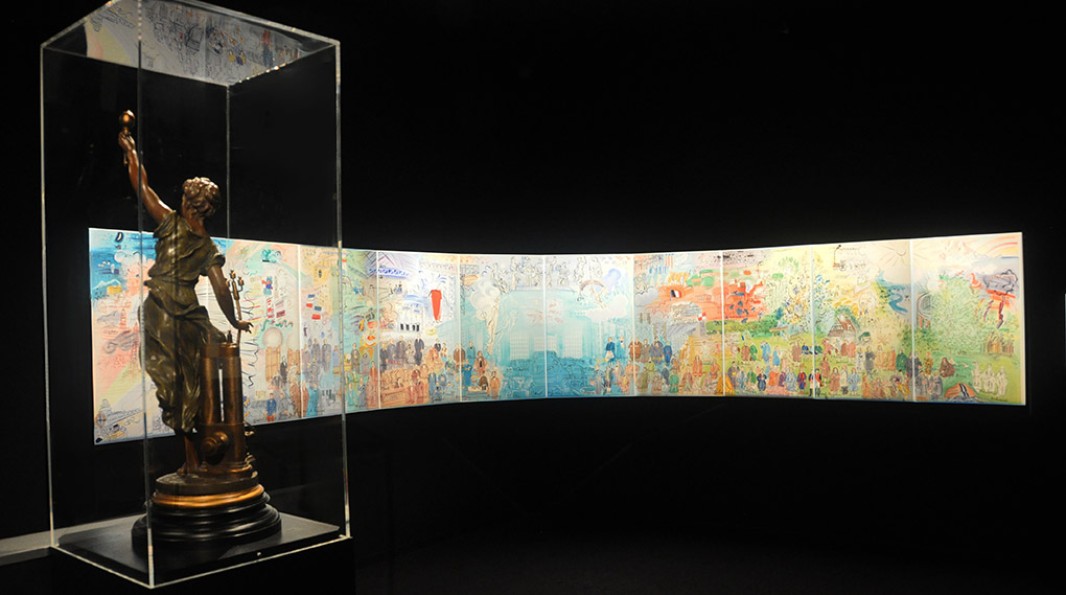
In 1937, the International Exhibition of Arts and Technology in Modern Life was held in Paris. To decorate the Light Pavilion, the CPDE (Compagnie Parisienne de Distribution d'Électricité, predecessor of EDF) commissioned Raoul Dufy to paint “La Fée Électricité” (The Electricity Fairy), which would be presented as the “largest painting in the world”: 60 meters by 10 meters. Dufy drew inspiration from 19th-century popular science books to compose this tribute to 109 historical figures, from Thales of Miletus to Pierre and Marie Curie.
Along with the commission for this monumental canvas (donated in 1954 by EDF to the Musée d'Art Moderne de la Ville de Paris), a series of lithographs was also commissioned, which Dufy supervised. It is this giant lithograph that you can admire in the new Art and Electricity space. Translated with DeepL.com (free version)
Experimentation – when artists use electricity to create
From the early twentieth century, artists began to explore the applications of electricity: its effects of light, magnetism, sound. All the avant-gardes made extensive use of these new practices and contributed to the birth of the great artistic movements of the last century, such as Dadaism, kinetic art, optical art or pop art and others.
In 1931, Charles Malégarie, director of the CPDE and patron of avant-garde artists, commissioned the surrealist photographer Man Ray to produce a portfolio of ten rayographs on the theme of electricity.
A rayograph, a technique invented by Man Ray in 1926, consists of placing on a sheet of photosensitive photographic paper objects that are more or less transparent and exposing this composition to light.
Rapidly recognised as a major work, Électricité is without doubt Man Ray’s most avant-garde creation.
Man Ray, Électricité, 1931
Plate taken from the portfolio of ten rayographs commissioned by the Compagnie parisienne de distribution d'électricité (CPDE).
Preface: Pierre Bos
EDF Group Foundation Collection. DR.

Other impressive artworks in the exhibition include:
- Pol Bury's Fontaine
Pol Bury, one of the founders of kinetic art, became interested in new technologies at an early age. In his Fontaines, as a master of slow movement, he used the balance of a hydraulic device to express the passage of time in what he called “these humble movements of stillness". - Continuel-lumière by Julio Le Parc
Julio Le Parc is one of the main representatives of Optical Art (Op-Art) and later of luminokinetic art. He combined engines and electric lamps to express a new artistic language that was accessible to everyone. - Two works by Costis
By taming lightning as an “energy sculpture”, Costis creates an “alphabet of ephemeral forms” that, in a random and fleeting way, offers a poetic and symbolic metaphor for this natural phenomenon. - Three digital paintings by Bernard Caillaud
A physics graduate, Bernard Caillaud went on to become a painter and then a photographer. In the early 1980s, he explored computer programming and digital art. These algorithmic digital paintings in light boxes are the result of a dialogue between the algorithms devised by the artist and the partially random images that appear on the screen.
Most of the works displayed in this space belong to the EDF Group Foundation. They were acquired on the occasion of monographic or thematic exhibitions presented since 1990 at the Espace Fondation EDF, Paris 7th arrondissement.
This installation received financial support from Mulhouse Alsace Agglomération and EDF.